
BACK TO ARTICLES & BLOGS
Loading...
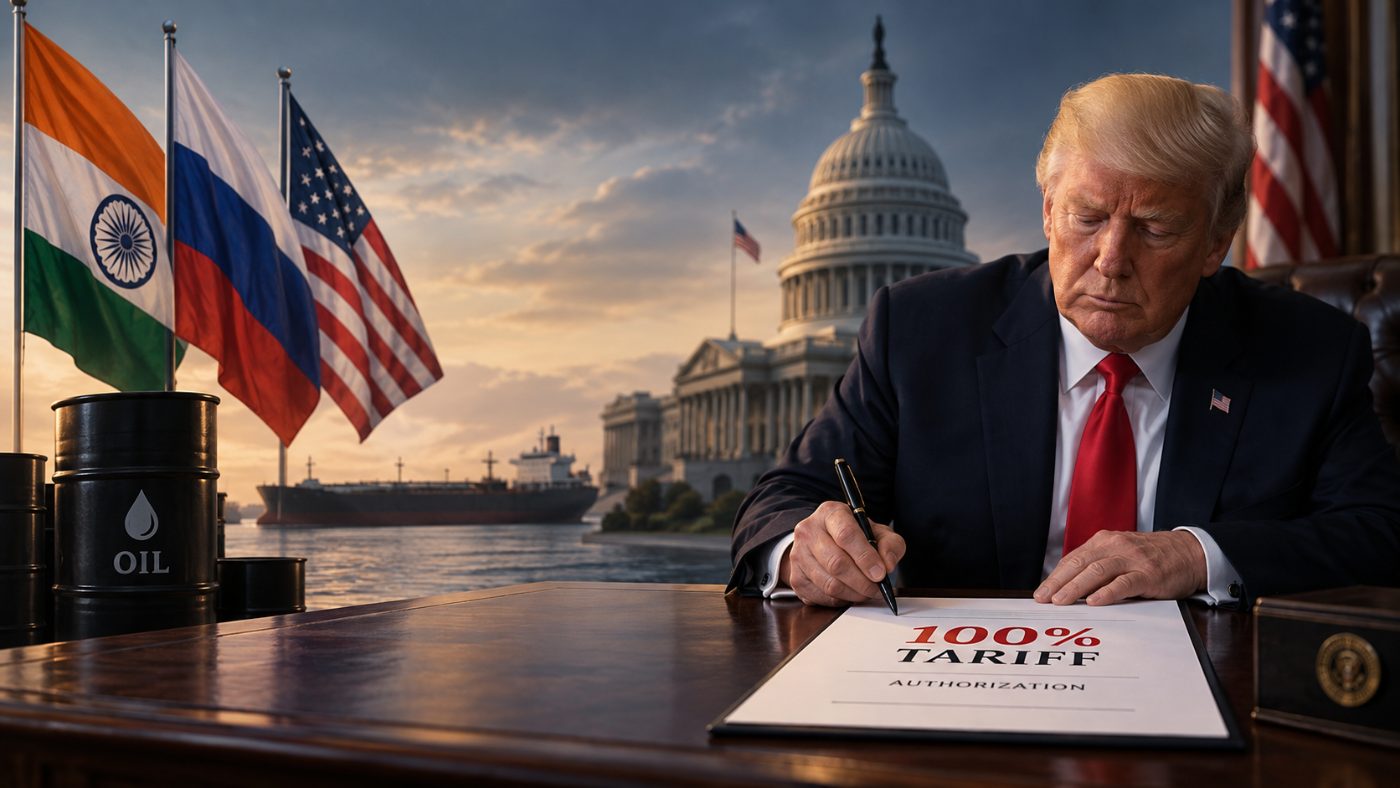
100% Tariff Threat: Why Trump’s New Russia Sanctions Bill Has India Watching Closely
The US Congress has cleared a sweeping Russia sanctions bill that could give President Donald Trump the power to impose tariffs of up to 100% on major buyers of Russian energy. India and China are among the countries that could face the new tariff mechanism.
The legislation, formally known as the Lindsey O. Graham Sanctioning Russia and Iran Act of 2026, passed the US House of Representatives on September 16 by 262–159, after clearing the Senate in August. It now heads to President Donald Trump for his signature.
But there is an important distinction: the bill itself does not immediately impose a 100% tariff on Indian goods. Instead, it creates a legal mechanism under which the US administration can impose tariffs of up to 100% on countries that meet specific conditions involving Russian oil, natural gas or sanctions evasion.
The legislation is primarily designed to increase economic pressure on Russia and Iran, while also targeting countries and entities that help sustain Russian energy revenues.
One of its most significant provisions is Section 113, which deals with what are known as secondary tariffs.
Under the provision, countries can become subject to tariffs if they are among the largest importers of Russian crude oil or natural gas and continue making qualifying purchases after the law takes effect. The provision also covers countries identified among the top five facilitators of Russian oil sanctions evasion.
The legislation allows the tariff rate to go as high as 100% on goods imported into the United States from qualifying countries.
The key point: 100% is a maximum authorised rate, not an automatic tariff rate on India.
The bill also requires reassessment of the five largest Russian oil and gas importers every 180 days, creating a mechanism that can change which countries fall within the tariff framework.
India has become one of the world's major buyers of Russian crude since Russia's invasion of Ukraine disrupted the global energy market.
Russian oil became particularly important for Indian refiners because it offered a competitive source of crude and helped India maintain a diversified energy supply.
Recent data cited by Indian financial publications shows Russia accounting for a substantial share of India's crude imports. Financial Express reported that Russia supplied around 45% of India's crude imports in August 2026, equivalent to roughly 2 million barrels per day.
That makes Washington's new tariff mechanism particularly significant for New Delhi.
The issue is not simply about oil. It connects energy security, foreign policy and India's access to the US consumer market.
New Delhi has responded cautiously.
Following the House vote, India's Ministry of External Affairs said the country would take “all necessary steps to protect its trade and economic interests”, while emphasizing the importance of maintaining energy security for India's population.
For India, the calculation is complicated.
Reducing Russian oil purchases could ease pressure from Washington, but replacing a large volume of crude quickly could also affect procurement costs, refinery economics and the overall energy market.
This becomes even more significant when global oil markets are already facing geopolitical disruptions.
If the maximum tariff were actually imposed broadly on Indian goods, the consequences would be substantial.
A 100% tariff would effectively add an amount equal to the value of the imported product to its US customs duty, before considering other applicable charges.
That could put significant pressure on industries that depend heavily on the American market, including:
Textiles and apparel
Engineering goods
Chemicals
Pharmaceuticals
Gems and jewellery
Marine products
Machinery and manufactured goods
However, the actual impact cannot be calculated simply by assuming that every Indian product will suddenly face a 100% duty.
The eventual outcome would depend on whether India is designated under the law, what tariff rate is selected, which products are covered and when the measures are implemented. Indian exporters are therefore watching Washington closely rather than treating the maximum rate as an immediate reality.
The development is particularly notable because US-India trade relations have already gone through a major tariff cycle this year.
In February, Washington announced an interim trade framework under which the US would apply an 18% reciprocal tariff rate to certain Indian goods, while the additional 25% tariff linked to India's Russian oil purchases was removed following India's commitment to stop those purchases.
The new Russia sanctions legislation introduces another layer of uncertainty.
It does not simply replace the existing tariff rate with 100%. Instead, it gives the US administration another statutory route to increase tariffs if the conditions specified in the law are met.
That difference matters.
The legislation could become more than a sanctions instrument.
Because Section 113 allows tariff rates to be adjusted and provides for presidential waiver authority under certain conditions, the measure could also become part of broader negotiations with countries buying Russian energy.
This is why some trade analysts are focusing less on the headline “100% tariff” and more on the uncertainty surrounding its potential use.
The Economic Times reported that Indian exporters and trade watchers are waiting to see the eventual tariff rate, product coverage and implementation timeline before assessing the full economic impact.
The dispute ultimately puts two priorities against each other.
For Washington, reducing Russian energy revenues is part of the broader effort to increase economic pressure on Moscow.
For New Delhi, affordable and reliable energy remains a central economic consideration.
India therefore faces a difficult balancing act: maintaining energy security and diversified crude supplies while managing the potential consequences for one of its most important export markets.
• The US House passed the Russia sanctions bill 262–159.
• The Senate had already approved the legislation.
• Section 113 authorises tariffs of up to 100% on qualifying countries.
• India and China are among the major Russian-energy buyers under scrutiny.
• The 100% rate is not an automatic tariff on all Indian goods.
• The actual impact will depend on US implementation, tariff rates and product coverage.
• India says it will protect its trade and economic interests while maintaining energy security.
The headline number is 100%, but the real story is about leverage.
The legislation gives Washington another powerful instrument to pressure countries that continue buying Russian energy. For India, the challenge now is navigating the space between energy security, strategic autonomy and access to the American market.
What happens next will depend not only on whether President Trump signs the legislation, but also on how the administration chooses to use the powers Congress has given it.
Comments (0)
No comments yet. Be the first to share your perspective.